What to Look for in a Video Production Studio in Tampa Bay
When you are evaluating a production studio in Tampa Bay, the right choice depends on what your production actually needs. Square footage matters, but so does ceiling height, power capacity, sound isolation, loading access, control-room connectivity, and the support spaces your crew will use between setups. This guide walks through the key factors to assess before signing a studio rental agreement.
Quick answer: A production studio in Tampa Bay should be evaluated on usable floor space, ceiling height, power infrastructure, sound isolation, loading and vehicle access, lighting-grid coverage, control-room capability, and support areas including green rooms, HMU, and parking. The right studio depends on your specific production type and crew size.
Start With Your Production Type
Before comparing square footage or or comparing rates, define what your production actually requires.
A commercial shoot with multiple setups needs different infrastructure than a weekly livestream. A multi-camera podcast is not the same as a film scene with a practical vehicle. A corporate webinar has different requirements than a product launch event.
Once you know your production type, you can evaluate studios against what that type of production actually needs, rather than using a general checklist that may not apply.
Space and Ceiling Height
Raw square footage is one metric. Usable square footage is what matters.
Evaluate the studio footprint in the context of your setup. A 3,000 sq. ft. stage with columns in the center may work differently than a clear-span space of the same size. Ceiling height determines whether you can fly overhead lighting, build tall sets, or shoot with a jib or crane without adjustments.
For large productions involving set builds, vehicles, or extended camera movement, look for unobstructed floor space with a clear ceiling height that accommodates the rig you plan to use.
Power Infrastructure
Productions require power. Not all studios are wired the same way.
Ask about available amperage, panel locations, and how power is distributed across the stage floor. A studio that can run a full lighting package for a commercial shoot without sharing circuits with HVAC systems or tenant spaces is a different facility than one where power management becomes part of the day.
Confirm whether power distribution is included, metered, or requires a separate agreement.
Sound Isolation
Sound isolation affects how many production types a studio can serve simultaneously and what bleeds into your recording.
A studio located near major road traffic, flight paths, or with thin shared walls will require more time and cost to manage acoustically than a purpose-built production facility. If audio is a primary deliverable on your project, ask how the studio manages sound isolation and whether HVAC, mechanical noise, and external interference have been addressed.
Loading, Vehicle, and Equipment Access
For any production moving significant equipment, the access point matters as much as the stage itself.
Evaluate whether the studio has a dedicated loading area, a ground-level bay door, or a dock that accommodates standard production vehicles. A roll-up bay door with a loading dock allows grip trucks, camera vans, and equipment cases to move directly onto the stage without stairs, freight elevators, or narrow corridors.
Productions involving vehicles on set require a bay door wide and tall enough to accommodate the specific vehicle. Confirm clearances before booking.
Lighting Grid Coverage
A built-in lighting grid changes how you approach a production day.
A studio with overhead grid coverage across a large portion of the stage allows you to fly fixtures, establish soft overhead exposure, and reconfigure looks without setting up and striking floor stands between every setup. Confirm how much of the floor area the grid covers, what the grid is rated for, and whether fixtures and dimming are available through the studio or must be brought in.
Control Room and Broadcast Connectivity
If your production involves multi-camera switching, livestreaming, remote guests, or transmission, the studio's control-room capability is a primary factor.
A facility with a dedicated control room allows a technical director to switch a live program, monitor incoming and outgoing feeds, and manage a broadcast from the same building. Ask whether the control room is included in studio rental, separately staffed, or available as a technical add-on.
Support Spaces
A production does not stop at the stage edge.
Green rooms, makeup and hair areas, kitchens, production offices, and parking determine how efficiently a cast and crew can function across a full day. A studio that offers these spaces on-site reduces the logistics overhead that comes with managing talent, crew meals, and equipment storage across multiple locations.
Outside Crews and Production Team Access
Confirm whether outside production teams are welcome to bring their own crew and equipment.
Some studios operate as production companies and prefer to supply labor, cameras, and technical services. Others are built specifically for outside teams, offering the infrastructure without requiring you to use in-house services. Knowing which model a studio operates under before you book prevents conflicts on the day.
Optional In-House Support
Even in a studio built for outside crews, optional in-house services can streamline production.
Engineers, technical directors, preferred crew lists, production support, livestreaming, line cuts, transmission, and post-production services may be available through the studio or its preferred partners. These are add-on services, not automatic inclusions in a basic rental.
Evaluating Shear Media Studios
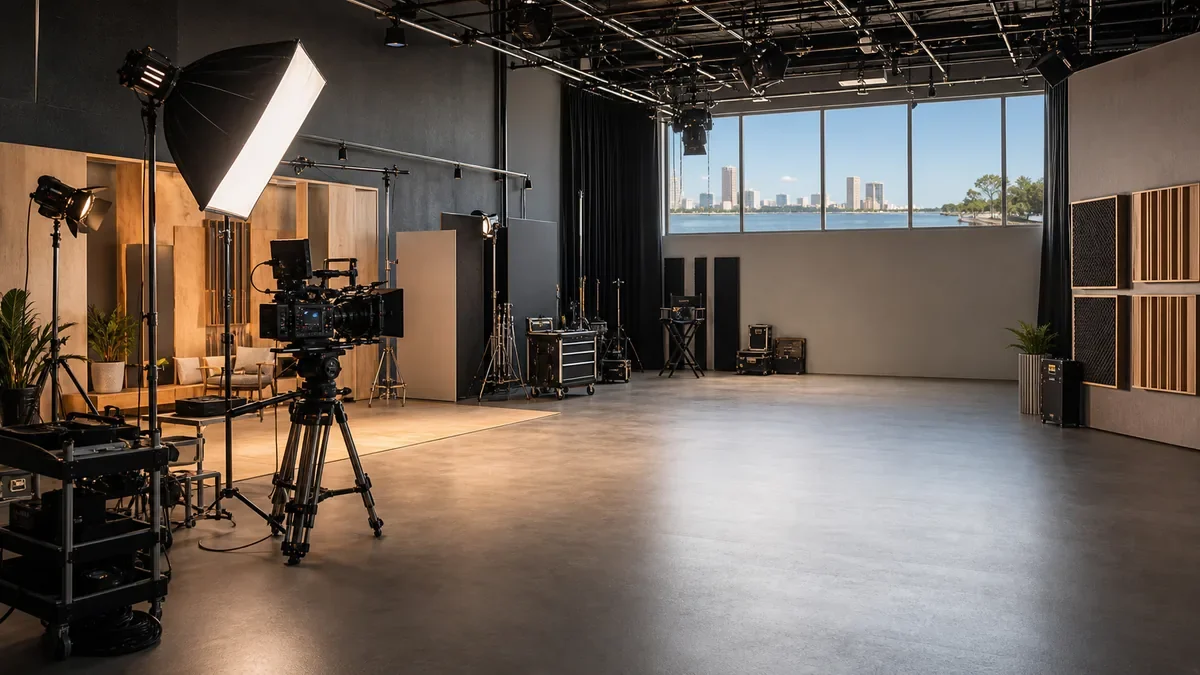
Shear Media Studios is an approximately 15,000 sq. ft. production studio in St. Petersburg serving Tampa, Clearwater, and the greater Tampa Bay area.
The facility includes two primary stages: Studio A at approximately 2,800 sq. ft. with a controlled-lighting environment and cyclorama capability, and Studio G at approximately 5,800 sq. ft. with a roll-up bay door, loading dock, and more than 2,500 sq. ft. of lighting-grid coverage. Support areas include green rooms, HMU, a kitchen, parking, and production support spaces. A control room provides connectivity for multi-camera, broadcast, and livestream productions.
Outside production teams are welcome to bring their own crews, cameras, and equipment. In-house engineers, production support, and technical services are available when needed.
Schedule a Tour
Before committing to a studio rental, visit the facility and walk it with your specific production in mind. Ceiling heights, power panel locations, bay-door clearances, and control-room configurations are details that matter more in person than on a spec sheet.
Contact Shear Media Studios to schedule a tour or discuss your production.
If your project requires a large stage or vehicle access, see large production studio rental options in Tampa Bay. For podcast and video podcast setups, see our podcast studio rental guide for Tampa Bay.
FAQ
What should I look for when renting a production studio in Tampa Bay?
Evaluate usable floor space, ceiling height, power capacity, sound isolation, loading access, lighting-grid coverage, control-room connectivity, and support areas. The right studio depends on your production type. A commercial shoot, a livestream broadcast, and a weekly podcast series each require different infrastructure, so match the facility to what your production actually needs.
How much does it cost to rent a production studio in Tampa Bay?
Studio rental rates vary based on the space, the length of the rental, the services included, and the production type. Contact Shear Media Studios directly for current rental rates and available production packages.
What is the difference between a studio with a control room and a standard studio rental?
A studio with a control room can support multi-camera switching, livestream production, incoming and outgoing broadcast feeds, and remote guest management from the same facility. A standard stage rental typically provides floor space and power without dedicated broadcast infrastructure. If your production involves live or multi-camera output, control-room access is a separate capability to confirm.
Can I bring my own production crew to a Tampa Bay studio?
Yes. Shear Media Studios is built for outside production teams. You may bring your own crew, cameras, and equipment. In-house engineers, production support, and technical services are also available as optional add-ons when needed.
What is the difference between Studio A and Studio G at Shear Media Studios?
Studio A is approximately 2,800 sq. ft. and designed for controlled video production including commercials, interviews, green-screen work, and multi-camera setups. Studio G is approximately 5,800 sq. ft. with a roll-up bay door, loading dock, and more than 2,500 sq. ft. of lighting-grid coverage, suited for large set builds, vehicles, events, and recurring productions requiring an open footprint.
What support spaces does a Tampa production studio need?
Green rooms, makeup and hair areas, a kitchen or catering access, production offices, on-site parking, and equipment storage are the core support spaces for a full production day. Studios that provide these on-site reduce the logistical overhead of managing cast and crew across multiple locations.