Remote production is a broadcast format where the primary production control is managed from a central facility while cameras and feeds originate from one or more remote locations. Line cuts are real-time editorial decisions made during a live production by a technical director operating a video switcher. Both concepts are relevant for any production team evaluating a Tampa Bay studio for live broadcast work. This article explains how these production models work and what a studio needs to support them.
Quick answer: Remote production from a Tampa studio means the facility receives camera feeds from remote locations, manages signal routing, and delivers a finished program output in real time. A line cut is a live editorial decision made by a technical director switching between sources during a live production. Both require a dedicated control room, reliable transmission infrastructure, and experienced technical staffing. Confirm all of this before booking.
What Remote Production Means
Remote production goes by several names: REMI (Remote Integration Model), at-home production, centralized production. The concept is consistent: cameras and audio capture equipment are deployed at a remote location (a sporting event, a live performance, a field location), and the production control and switching happen at a central studio facility rather than on-site.
This model reduces the size and cost of the on-location crew because only the essential capture personnel travel to the site. The technical director, producer, audio mixer, and graphics operators work from the studio facility, receiving feeds from the remote location over IP, fiber, or satellite.
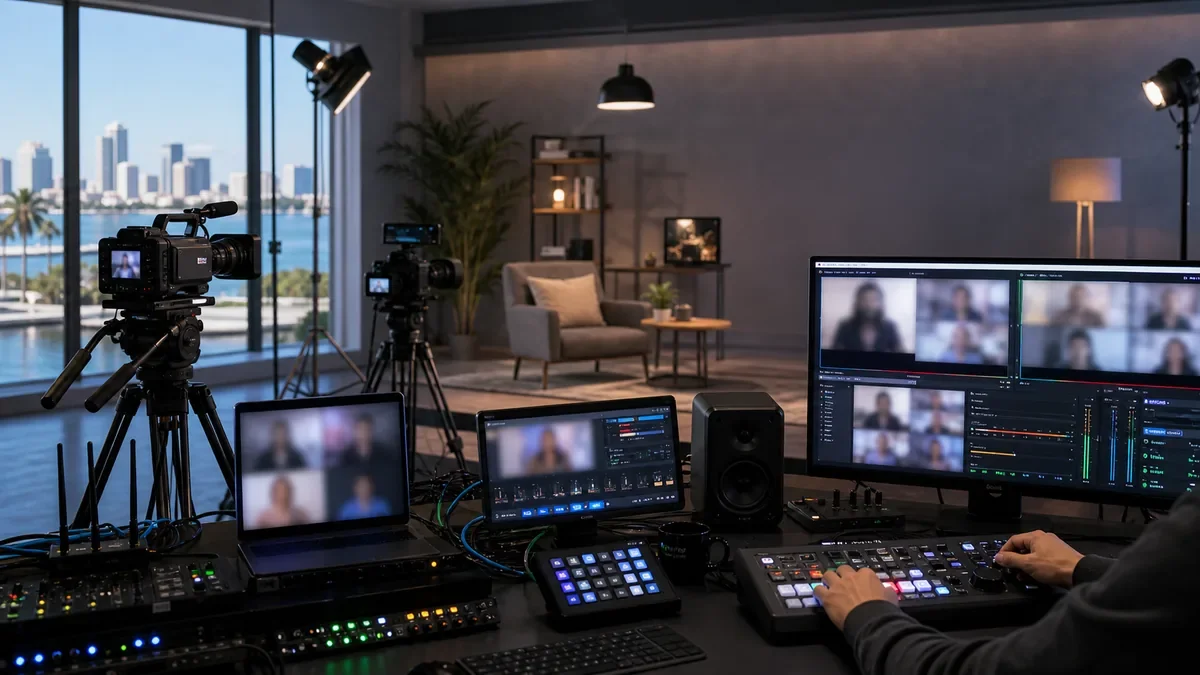
For a Tampa studio to support remote production, it needs the ability to receive and manage incoming feeds from remote locations, a control room capable of switching and mixing those feeds in real time, and the transmission infrastructure to deliver the finished program to the distribution platform.
What a Line Cut Is
A line cut is the live program output produced in real time by a technical director during a broadcast.
The technical director receives multiple video inputs: different camera angles, remote guest feeds, pre-produced graphics and video packages, and presenter close-ups. The line cut is the real-time editorial decision of which input is on screen at any given moment, managed via a hardware or software video switcher in the control room.
A production that relies on editing in post does not produce a line cut. A live program delivered in real time always has a line cut. The quality of the line cut depends on the skill of the technical director, the responsiveness of the switching system, and the reliability of the incoming feeds.
Studio Requirements for Remote Production Support
Supporting a remote production is technically more demanding than a standard live production.
The studio needs to receive incoming feeds from remote locations reliably, which requires dedicated bandwidth and encoding infrastructure for the incoming signals. It needs to manage those feeds alongside any in-studio camera inputs simultaneously. The control room needs sufficient input capacity for all active sources. And the technical team needs experience with the specific encoding protocols and IP transport methods the remote production is using.
Confirm the studio's incoming bandwidth capacity, whether they have experience with IP-based remote production workflows, and what encoding formats and transport protocols their system supports.
Transmission and Signal Delivery for Line Cuts
A line cut produced in the studio control room needs to be delivered to its destination in real time.
That destination may be a streaming platform, a broadcast network, a satellite uplink, or a corporate network. Each delivery method has different technical requirements and different latency profiles. Confirm that the studio's transmission capability matches the delivery format your production requires and that the technical team has managed that delivery format before.
Technical Staffing for Remote Production
Remote production and live line cuts require experienced technical staffing.
A technical director who has operated a switcher for live programs manages the pace and quality of the line cut. An audio engineer who manages incoming feeds from remote locations in real time prevents the audio issues that are common in complex remote productions. A transmission engineer monitors the outgoing signal and manages platform delivery.
These are specialized roles. Confirm that the studio's in-house technical team has experience with the specific type of remote production you are planning.
When Remote Production Applies
Not every production requires a remote production model.
Remote production makes sense when: the primary camera capture is happening at a location that cannot support a full technical crew, and the editorial control needs to happen in a stable studio environment. Sports broadcasts, live event coverage, field reporting for news programs, and some corporate events fit this model.
For productions where all camera positions are in or adjacent to the studio, remote production infrastructure is not the primary consideration. The focus shifts to the studio's control room capability and the quality of the in-house technical team.
Shear Media Studios for Remote Production and Broadcast
Shear Media Studios is an approximately 15,000 sq. ft. production studio in St. Petersburg serving Tampa, Clearwater, and the greater Tampa Bay area. The facility includes a control room for live switching and broadcast productions. In-house engineers and technical production support are available for remote production and line-cut productions when needed.
Studio A serves as the primary studio environment for broadcast productions and remote program management. For larger productions with higher crew counts, Studio G provides additional floor space.
Contact Shear Media Studios to discuss your remote production requirements, incoming feed specifications, and technical staffing for your production dates.
For an overview of broadcast studio infrastructure, see broadcast studio rental in Tampa Bay. For professional livestream productions, see livestream studio in Tampa Bay.
FAQ
What is remote production in a broadcast studio context?
Remote production means camera feeds from a remote location are received and switched at a central studio facility. The technical director, audio mixer, and producer work from the studio while only essential capture crew are on-site at the remote location. This reduces on-location crew costs while maintaining studio-quality production control.
What is a line cut?
A line cut is the real-time program output produced by a technical director switching between video sources during a live broadcast. It is the editorial decision of which camera angle or input is on screen at any given moment. A line cut is produced live. It cannot be created in post-production; that is an edit.
What does a studio need to support remote production?
The studio needs incoming bandwidth to receive remote feeds, a control room with sufficient input capacity for all sources, transmission infrastructure to deliver the finished program output, and technical staffing experienced with IP-based remote production workflows. Confirm all of these before booking.
Can Shear Media Studios support remote production workflows in Tampa Bay?
The facility includes a control room and in-house technical support for broadcast and live switching productions. Contact Shear Media Studios directly to discuss remote production requirements, incoming feed specifications, and technical staffing availability.
What is the difference between a line cut and an edited video?
A line cut is produced in real time during a live broadcast. An edit is assembled in post-production after recording. A line cut is required for live programs delivered in real time. An edit is appropriate for recorded content delivered after production is complete.
How much does remote production support cost at a Tampa Bay studio?
Remote production support rates depend on the control room requirements, technical staffing, incoming feed volume, transmission delivery, and event duration. Contact Shear Media Studios directly for current rates and production packages.