Film Studio Rental in Tampa Bay: A Producer's Guide
Film productions have specific infrastructure requirements that differ from commercial, event, or broadcast productions. Set build timelines, practical vehicle and prop clearances, extended rental periods, crew size, and technical connectivity all factor into which studio is the right fit. This guide covers what producers should evaluate when booking a film studio rental in Tampa Bay and what to confirm before committing a production to a stage.
Quick answer: A film studio rental in Tampa Bay should be evaluated on clear-span floor space, ceiling height for set builds and rigging, power distribution for full lighting packages, loading and vehicle access, extended rental policies for multi-day shoots, and support areas scaled to full film crew operations. The right stage depends on the specific production needs. Contact the studio directly to confirm all specifications before locking your location.
Stage Size and Configuration for Film Productions
Film sets require more floor space than most productions think they need on paper.
A set that reads as a single room may require wall flats, ceiling pieces, practical lighting, a camera dolly track running the full length of the space, and a crew of 30 or more managing the shot at any given time. Add to that the craft services, equipment staging, and production office needs, and the floor space requirement grows quickly.
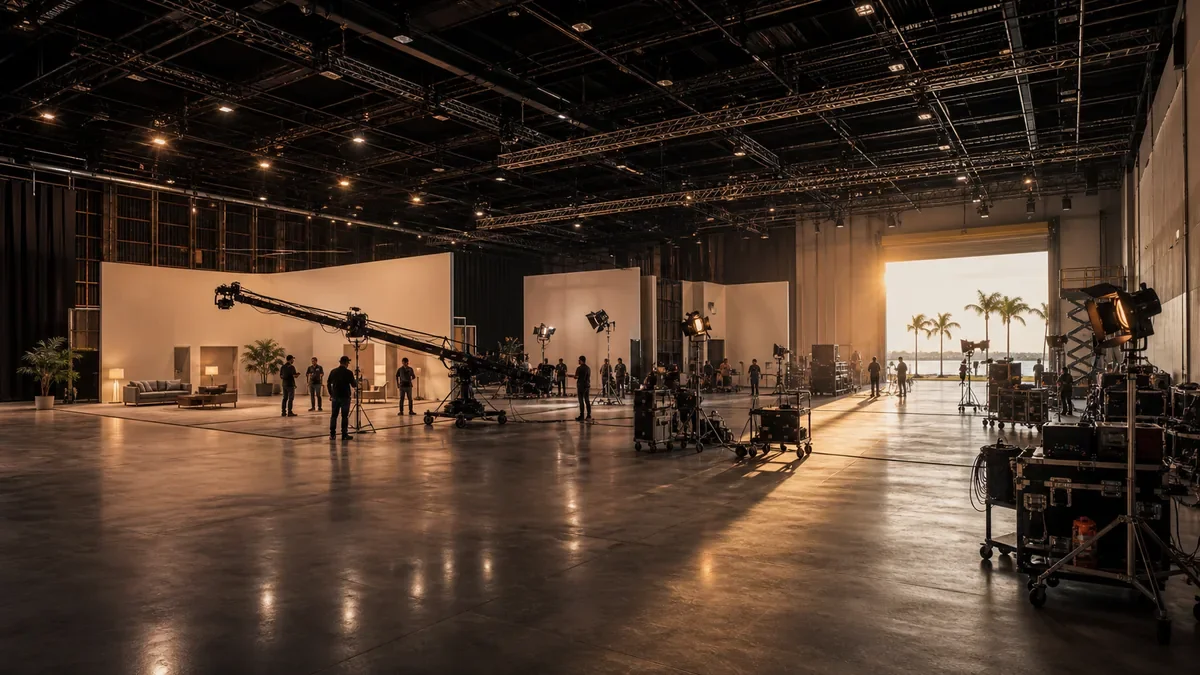
For film productions, look for clear-span stages with no structural interruptions in the working area. A 5,000 to 8,000 sq. ft. clear-span stage gives a production team the flexibility to build and light without working around the building's structure.
Ceiling Height for Practical Set Builds and Rigging
Ceiling height is a primary consideration for film stage rentals.
Set walls built at full practical height require ceiling clearance to stand and be safely rigged. Overhead camera rigs, cranes, and jibs require ceiling height above the top of the set piece. A studio with 18-foot or higher ceilings gives a production team significantly more flexibility than one with a 12-foot ceiling.
Confirm the ceiling height at multiple points across the stage, not just at the perimeter. Some stages have lower sections near mechanical equipment or structural beams that create practical limitations on set placement.
Power for Film Lighting Packages
Film lighting packages run heavier than commercial or event setups.
A narrative film production may run multiple HMI units, a full LED overhead rig, practical lights throughout the set, and additional fill and accent units simultaneously. This requires significant electrical capacity that is distributed cleanly across the stage without creating shared circuit conflicts with HVAC or building utilities.
Ask about total available amperage, how power panels are located relative to the stage floor, and whether the studio has experience supporting full film lighting packages for multi-day shoots.
Loading Access for Film Grip Trucks
Film productions move significant equipment. The loading access is not a secondary detail.
A roll-up bay door with a loading dock allows the grip truck, electric truck, camera van, and production support vehicles to park adjacent to the stage and move equipment directly onto the floor without stairs, freight elevators, or long carry distances. For multi-day shoots, the logistics of equipment movement in and out of the stage directly affects your production schedule.
Confirm the bay door dimensions, the dock configuration, and whether the loading area is dedicated to your production or shared.
Extended Rental and Multi-Day Shoot Policies
Film productions rarely wrap in a single day.
Confirm whether the studio offers extended rental agreements that allow your production to hold the stage across multiple shoot days, whether set pieces can remain standing between days, what the access procedure is for early call times and late wraps, and whether after-hours access is available.
A studio that closes at 6 PM and requires a complete set strike between days is not the right facility for a narrative film production building practical environments.
Crew Access and Support Areas
Film crews are larger than most other production types.
A full film crew on a studio shoot may include 50 or more people in the building simultaneously: cast, camera department, grip and electric, art department, hair and makeup, wardrobe, sound, assistant directors, and production assistants. The studio's support areas need to accommodate this scale: green rooms for cast, a hair and makeup area, production office space, parking for multiple vehicles, and kitchen or catering access.
Confirm that the studio's support spaces are scaled to your crew size before booking.
Control Room Connectivity for Film Productions
Not all film productions require a control room, but some do.
Productions that include a live broadcast element, a multi-camera capture without post-editing, or a distributed feed to remote locations need dedicated control room access. Confirm what the studio's control room supports and whether it is included in the rental or a separate arrangement.
Shear Media Studios for Film Productions
Shear Media Studios is an approximately 15,000 sq. ft. production studio in St. Petersburg serving Tampa, Clearwater, and the greater Tampa Bay area. Studio G at approximately 5,800 sq. ft. with a roll-up bay door and loading dock is the primary stage for large film productions requiring significant floor space, vehicle integration, and extended set builds. Studio A at approximately 2,800 sq. ft. serves controlled-environment film scenes requiring cyclorama, green screen, or a tightly managed interior setup.
Outside production teams are welcome to bring their own crew, cameras, and equipment. In-house technical support is available when needed.
Contact Shear Media Studios to discuss your production's specific requirements and confirm stage availability for your shoot dates.
For an overview of what to evaluate in any Tampa Bay studio rental, see how to choose a production studio in Tampa Bay. For large-scale productions specifically, see large production studio rental in Tampa Bay.
FAQ
What should a producer look for in a film studio rental in Tampa Bay?
Evaluate clear-span floor space scaled to your set design, ceiling height for rigging and set builds, power distribution for full lighting packages, loading dock access for grip trucks, extended rental policies for multi-day shoots, and support areas scaled to your full crew size. Confirm all specifications directly with the studio before locking your production.
How much space does a film production need on a studio stage?
It depends on the set design, camera movement requirements, and crew size. A single-room set with a dolly track and full crew commonly requires 4,000 sq. ft. or more of clear-span space. Confirm the net usable stage area and ceiling height when evaluating options.
Can film productions build practical sets at Shear Media Studios?
Yes. Both Studio A and Studio G at Shear Media Studios accommodate set builds. Studio G at approximately 5,800 sq. ft. with a roll-up bay door and loading dock is the primary stage for larger set builds and vehicle integrations. Contact Shear to confirm the set build policy, strike requirements, and multi-day access for your specific production.
What power is available for film lighting packages at Shear Media Studios?
Contact Shear Media Studios directly to confirm available amperage, panel locations, and power distribution specifications for your production's lighting requirements.
Does Shear Media Studios allow extended film production rentals?
Contact Shear Media Studios directly to discuss multi-day and extended rental arrangements for your production dates.
Can I bring my own film crew and camera package to Shear Media Studios?
Yes. Shear Media Studios is built for outside production teams and welcomes film productions that bring their own crew, camera package, and equipment. In-house technical support is available as an optional add-on.