Not every production fits a 1,500 sq. ft. white cyc room. Film scenes with set builds, events with multiple camera positions, automotive productions with vehicles on stage, and broadcast programs with full crews need something larger. This article covers what to look for in a large production studio rental in Tampa Bay and what specifications matter most for scale productions.
Quick answer: A large production studio rental in Tampa Bay should offer at minimum 4,000 sq. ft. of unobstructed stage space, a roll-up bay door with vehicle and equipment access, robust power distribution, lighting-grid coverage across the majority of the floor, and on-site support areas for full crew operations. Contact the studio directly to confirm clearances and availability before booking.
What Qualifies as a Large Production Studio
The term "large" is relative, but for production purposes there are practical thresholds.
A studio under 2,500 sq. ft. is a controlled environment suited for interviews, green screen, small product shoots, and podcast setups. Once you are building any kind of practical set, running multiple camera positions simultaneously, or fitting a vehicle or large prop, the floor area requirements climb quickly.
For productions involving set builds with multiple rooms or walls, full crew with 20 or more people on stage, automotive or vehicle integration, large event formats, or extended multi-day builds, look for studios in the 4,000 to 8,000 sq. ft. range with a clear span floor and adequate ceiling height.
Floor Space and Clear Span
Available square footage is the baseline. What matters equally is whether the floor plan is clear span or interrupted.
A clear-span stage with no structural columns allows you to position cameras anywhere, run dolly track in any direction, and build sets without working around obstacles. A stage of the same footprint with columns or low-hanging obstacles in the work zone may not accommodate your layout.
Confirm the usable footprint, not just the total square footage. Some studios include loading corridors, equipment storage bays, and hallways in their total number. Ask for the net stage area and confirm the column layout before booking.
Ceiling Height for Large Shoots
Ceiling height determines what rigs you can use overhead and how tall your set elements can be.
A ceiling height of 20 feet or more allows you to fly Kino Flos and LED panels from above, use a jib or crane without risking the ceiling, and build set walls at full height. A 14-foot ceiling is workable for some productions but limits overhead rigging options and set build height.
Ask the studio for confirmed ceiling height at the center of the stage, not just the architectural maximum at the perimeter.
Roll-Up Bay Door and Loading Access
For large productions, the loading access is as important as the stage itself.
A roll-up bay door with a loading dock allows grip trucks, camera vehicles, equipment vans, and production cases to move directly onto the stage without stair navigation, freight elevator bottlenecks, or tight corridor clearances. If your production involves a vehicle on set, confirm the bay door dimensions, height, and whether the ramp or dock configuration accommodates the vehicle.
Productions that need to move large amounts of equipment in and out across a multi-day shoot benefit significantly from a dedicated loading area adjacent to the stage rather than a shared building entrance.
Power Distribution at Scale
Large productions run heavy lighting packages, camera systems, and support equipment simultaneously.
Ask about the studio's total available amperage, how power panels are distributed across the stage floor, and whether production power is separated from building HVAC and utility circuits. A studio that shares circuit capacity with other tenants or has limited panel access creates logistical challenges on heavy production days.
Confirm whether power distribution equipment is available through the studio or must be brought in, and whether there are usage metering or overage fees.
Lighting Grid Coverage
An overhead lighting grid changes how efficiently a large stage can be used.
On a large stage, a grid that covers 2,500 sq. ft. or more allows you to establish overhead exposure across a wide working area without relying entirely on floor stands and road cases. Confirm what percentage of the stage floor the grid covers, what the grid is rated to hold, and whether fixtures are available through the studio or require outside rental.
Support Areas for Large Crew Operations
Large productions require support space proportional to crew size.
A stage with 4,000-plus sq. ft. serving 30 crew members still needs functional green rooms, makeup and hair stations, a kitchen or catering area, production office space, parking, and equipment storage. Confirm that the studio's support areas scale to the production size before committing.
Multi-Day and Extended Productions
Large set builds often require more than one day, and some productions run for weeks.
Confirm whether the studio offers extended rental agreements, whether sets can be left standing between shoot days, and what the security and access arrangements are for overnight or multi-week productions. A studio with after-hours access and on-site security is a different operational environment than one that closes at 6 PM.
Studio G at Shear Media Studios
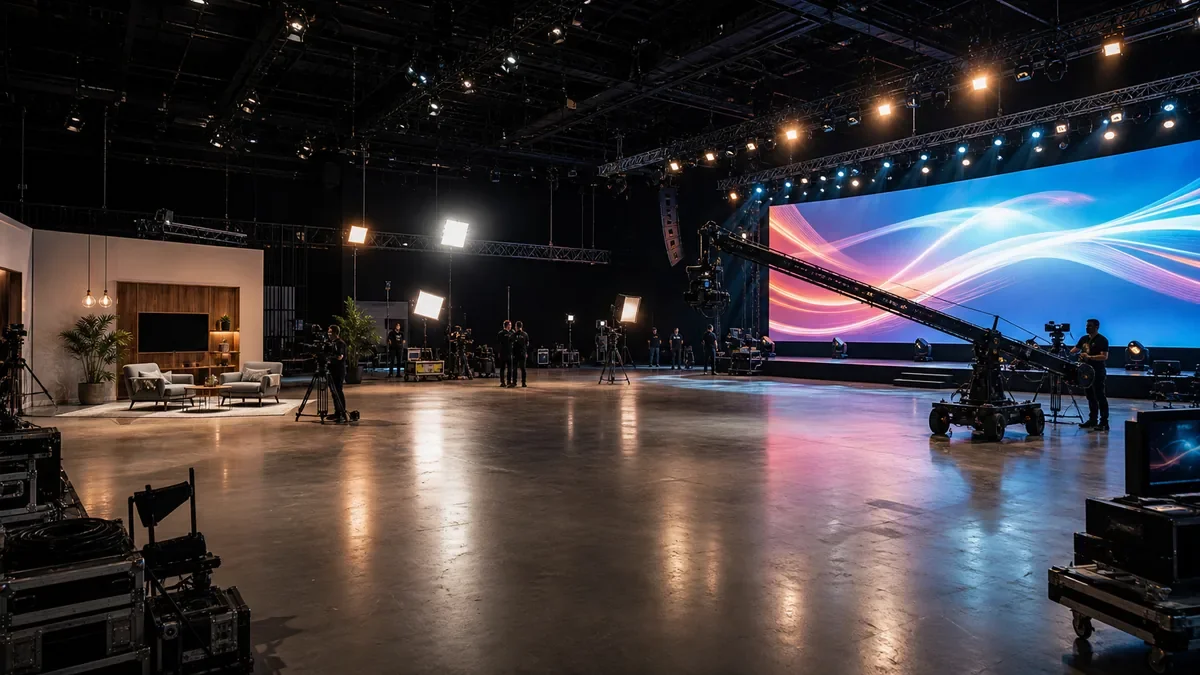
Studio G at Shear Media Studios is approximately 5,800 sq. ft. with a roll-up bay door, loading dock, and more than 2,500 sq. ft. of overhead lighting-grid coverage. The stage is designed for large set builds, vehicles, events, and recurring productions that need a substantial open footprint.
Shear Media Studios is an approximately 15,000 sq. ft. production studio in St. Petersburg serving Tampa, Clearwater, and the greater Tampa Bay area. Studio A at approximately 2,800 sq. ft. handles controlled-environment and green-screen productions when a smaller, fully managed stage is the right fit.
Outside production teams are welcome to bring their own crews and equipment. In-house engineers, production support, and technical services are available when needed.
Contact Shear Media Studios to discuss your production requirements and confirm availability for Studio G.
For an overview of what to evaluate in any Tampa Bay studio rental, see how to choose a production studio in Tampa Bay. If your production includes a vehicle bay or equipment staging area, see productions requiring a studio with a loading dock.
FAQ
What size production studio do I need for a large commercial or film shoot?
For productions with set builds, multiple camera positions, or full crews, a stage of at least 4,000 sq. ft. with a clear span floor and ceiling height of 18 feet or more is a practical starting point. The specific requirements depend on the set design, camera movement needs, and crew size. Confirm the net usable stage area, not just the total square footage listed.
Do large production studios in Tampa Bay have vehicle access?
Some do. Look for a roll-up bay door with an adjacent loading dock or vehicle ramp. Confirm the door height and width against the specific vehicle you plan to bring on stage. Shear Media Studios' Studio G has a roll-up bay door with a loading dock rated for production vehicles and equipment.
Can I build a set and leave it standing overnight at a Tampa Bay studio?
Extended and multi-day productions are common at full-service studios. Confirm the studio's policy on overnight set storage, access arrangements, and security before booking. Shear Media Studios may be able to accommodate multi-day and recurring production arrangements. Contact for details.
How much does it cost to rent a large production studio in Tampa Bay?
Rental rates for large stages vary based on the square footage, duration, services included, and production type. Contact Shear Media Studios directly for current rates and available packages for Studio G.
What is the lighting grid coverage in Studio G at Shear Media Studios?
Studio G has more than 2,500 sq. ft. of overhead lighting-grid coverage. This allows outside crews to fly fixtures across a large working area. Confirm whether fixtures and dimming are available through Shear or must be brought in when planning your production.
What support areas are available with large studio rentals?
Shear Media Studios includes green rooms, HMU areas, a kitchen, parking, and production support spaces. Confirm the specific configuration and capacity for your crew size when booking Studio G.